
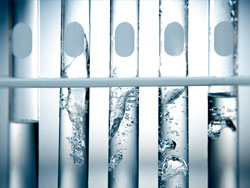
Advanced Waste Water Treatment’s Clear H2O Method is based on a water treatment technology known as electrocoagulation, which is sometimes referred to as EC. EC is the process of destabilizing suspended, emulsified, or dissolved contaminants from water by introducing an electrical current into an aqueous medium. The electrical current provides the electromotive force to drive the chemical reactions to cause the elements and/or compounds to approach a more stable state. Generally, this stable state is a solid that is either less colloidal, less emulsifiable, or less soluble than the element or compound at equilibrium values. As this occurs, the contaminants form hydrophobic entities, such as precipitates or phase separations, which can easily be removed by a number of secondary separation techniques.
The electrical current is introduced into the water via parallel electrodes constructed of various metals generally selected to optimize the removal process. The two most common electrode materials are iron (Fe) and aluminum (Al). In accordance with Faraday’s Law, metal ions will be split off or sacrificed into the liquid medium. This will form a nucleus, which will attract the contaminants into a precipitate that will be removed from the treated fluid. These metal ions tend to form metal oxide or hydroxide nuclei that are an electrocoagulation attractant to the contaminants, which have been destabilized. The quantity of electrical current required varies with the liquid to be treated. It is necessary to provide sufficient, but not excess, electrical current to remove the unwanted contaminants. Excess current only consumes excess electrical power and accelerates the process of module electrode consumption, resulting in increased treatment operating costs.
For more information regarding our Clear H2O Method, call us at (631) 213-1324 and speak with a representative today.